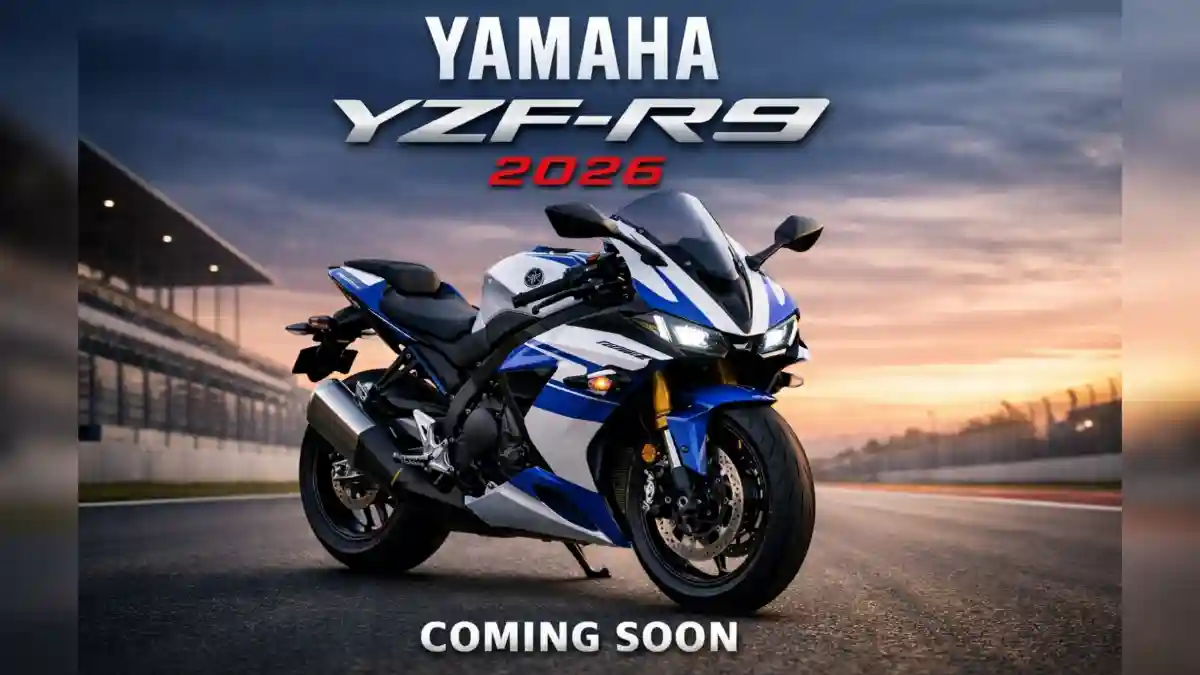
Yamaha YZF-R9: The global supersport motorcycle category has been undergoing a quiet but decisive transformation. Rising emissions regulations, changing rider demographics, and the shift away from extreme high-revving engines have forced manufacturers to rethink what performance means on public roads. Yamaha’s forthcoming Yamaha YZF-R9 sits at the center of this transition, representing a strategic reset rather than a simple model addition.
Unlike traditional supersport machines that chased peak horsepower figures above all else, the YZF-R9 is being positioned as a motorcycle built around usable performance, electronics-led control, and long-term relevance. For markets like India, where riding conditions vary dramatically and ownership costs matter as much as speed, this approach could prove decisive.
Supersport Category Shift and Yamaha Strategy
For more than two decades, Yamaha’s R-Series lineup defined different stages of sport motorcycling. Entry-level machines introduced riders to fairings and track-inspired ergonomics, while the R6 and R1 established reputations for razor-sharp handling and race-bred aggression. Over time, however, the middleweight supersport segment began shrinking as riders gravitated toward naked bikes and sport-tourers that offered similar performance with greater comfort.
Yamaha’s response has not been to abandon the supersport idea, but to reinterpret it. The R9 is designed to bridge the emotional appeal of a fully faired sport motorcycle with the everyday usability that modern riders increasingly expect. This philosophy aligns closely with Yamaha’s recent product direction globally, especially with the success of its CP-series engines.
Product Positioning Within Yamaha R-Series Lineup
The YZF-R9 is expected to sit between the R7 and R1 in Yamaha’s hierarchy, both in price and performance. This placement is significant. It suggests Yamaha is targeting riders who may find litre-class machines excessive for road use but want more substance than entry-level or twin-cylinder alternatives.
Rather than reviving the discontinued R6 in its original form, Yamaha appears to be acknowledging that the market has changed. Riders today prioritize torque delivery, electronic safety systems, and comfort just as much as lap times. The R9 is built to reflect that reality without abandoning the core identity of a supersport motorcycle.
Design Language Rooted in Racing Heritage
Visually, the YZF-R9 draws heavily from Yamaha’s modern R-Series design vocabulary. The front profile is sharp and compact, with a centrally mounted LED headlamp flanked by aerodynamic elements that mirror the design direction of Yamaha’s flagship machines. Body panels are sculpted for airflow management rather than pure aesthetics, contributing to stability at higher speeds.
The side fairings flow seamlessly into a muscular fuel tank and a raised tail section, creating a forward-biased stance that signals intent without appearing extreme. This balance between aggression and restraint is likely to resonate with riders who want a sporty presence without the impracticality of race replicas.
Engine Architecture and Performance Philosophy
At the core of the YZF-R9 is Yamaha’s well-established 890cc CP3 three-cylinder engine. This powerplant has already earned a reputation for combining strong mid-range torque with a distinctive exhaust note and linear throttle response. In R9 specification, the engine is expected to be tuned for sharper top-end performance while retaining its everyday rideability.
Industry reports suggest power output in the range of 115 to 120 PS, paired with torque figures that emphasize acceleration rather than outright top speed. This approach reflects Yamaha’s focus on real-world performance rather than chasing class-leading numbers that rarely translate into practical riding advantages on public roads.
For Indian riders, this configuration could offer a compelling blend of performance and manageability, especially on highways and twisty mountain roads where mid-range response matters more than peak horsepower.
Chassis Engineering and Suspension Setup
The R9 is expected to feature a lightweight aluminum frame derived from Yamaha’s sport platform architecture, optimized for rigidity and balanced weight distribution. This chassis philosophy prioritizes predictable handling and rider feedback, both critical for confidence at higher speeds.
Suspension components are likely to include fully adjustable inverted front forks and a rear monoshock, sourced from premium suppliers and tuned specifically for sport riding. Such adjustability allows riders to tailor the motorcycle to varying road conditions, rider weight, and riding style.
Braking hardware is expected to be equally serious, with large-diameter front discs and radial-mounted calipers delivering strong, consistent stopping power. Combined with advanced ABS calibration, the braking system is designed to inspire confidence rather than intimidation.
Electronics Suite Reflecting Modern Expectations
Modern supersport motorcycles are increasingly defined by their electronics, and the YZF-R9 is expected to reflect this trend comprehensively. A six-axis IMU forms the backbone of the system, enabling traction control, slide control, lift control, and cornering-sensitive ABS.
Multiple riding modes are expected, allowing riders to choose between relaxed street settings and more aggressive sport configurations. These systems are designed not to dilute the riding experience, but to enhance it by providing a safety net that operates unobtrusively in the background.
A full-color TFT instrument display is expected to serve as the control center, offering smartphone connectivity, navigation prompts, and customizable data layouts. This level of integration reflects Yamaha’s effort to keep the R9 relevant over a long ownership cycle.
Ergonomics and Day-to-Day Usability
One of the defining aspects of the YZF-R9 is its focus on usability. While still unmistakably a sport motorcycle, its riding position is expected to be less extreme than traditional supersport machines. Clip-on handlebars are positioned to reduce wrist strain, and footpeg placement balances ground clearance with comfort.
This ergonomics strategy suggests Yamaha envisions the R9 as a motorcycle that can handle commuting, weekend rides, and occasional track use without forcing riders to compromise on comfort or control. Fuel tank capacity is expected to support reasonable touring range, further reinforcing its everyday credentials.
India Market Expectations and Launch Outlook
In the Indian context, the YZF-R9 is widely expected to arrive as a premium import, likely via the completely built unit route. While Yamaha India has not officially confirmed launch timelines or pricing, industry observers anticipate a 2026 introduction aligned with global availability.
Price estimates place the motorcycle in the range of ₹12 lakh to ₹14 lakh ex-showroom, positioning it against premium middleweight offerings from European manufacturers. This pricing reflects its advanced electronics, premium components, and performance orientation.
For Indian enthusiasts, the R9 represents a potential shift in Yamaha’s commitment to the high-performance segment, offering an alternative to naked sport machines without the extremes of litre-class superbikes.
Ownership Perspective and Long-Term Relevance
Beyond specifications and performance figures, the true significance of the YZF-R9 lies in its long-term positioning. Yamaha appears to be building a motorcycle designed to remain relevant across changing regulations and rider expectations. Its emphasis on electronics, torque-rich performance, and balanced ergonomics suggests a product aimed at sustained appeal rather than short-term hype.
If introduced in India with appropriate aftersales support and realistic pricing, the R9 could redefine what a supersport motorcycle means in a market increasingly focused on versatility and value.