
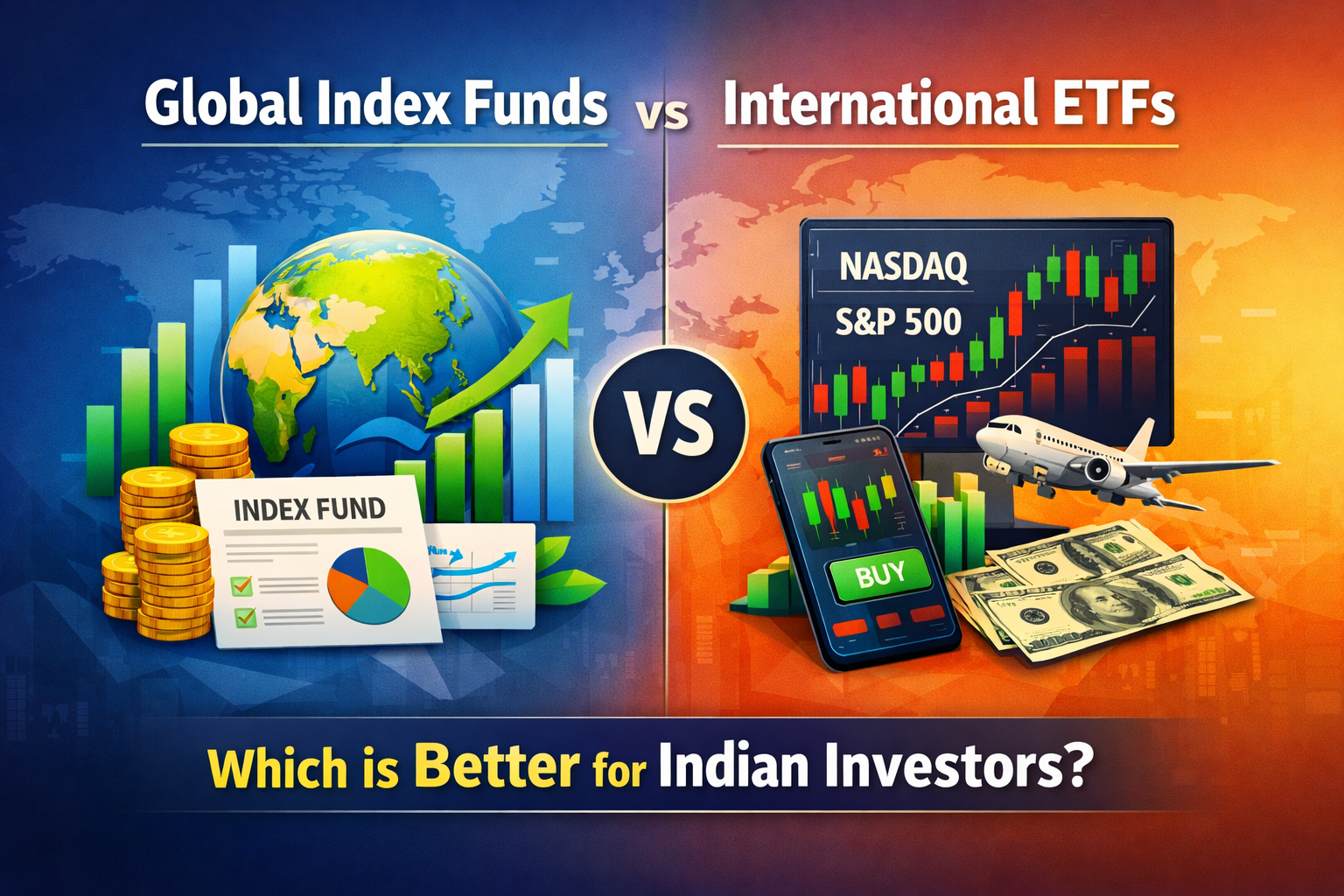
Investing only in the Indian stock market can limit diversification. Many investors today want exposure to global companies such as those listed in the United States, Europe, or other developed markets. This is where global investment options like global index funds and international ETFs become important.
Both investment options allow Indian investors to participate in global markets, but they work in slightly different ways. Understanding these differences is important before deciding which option suits your investment strategy.
This guide explains what global index funds and international ETFs are, how they work, their advantages and disadvantages, and which option may be better for Indian investors.
What Are Global Index Funds?
A global index fund is a mutual fund that tracks an international market index. Instead of actively selecting stocks, the fund simply replicates the performance of a specific global index.
For example, a fund may track major global benchmarks such as the S&P 500 or the NASDAQ‑100.
When you invest in a global index fund, your money is distributed across multiple companies included in that index. This means you gain exposure to many international businesses without buying individual stocks.
How Global Index Funds Work
These funds collect money from investors and invest it in stocks that mirror a particular global index. If the index grows, the fund’s value increases accordingly.
Indian mutual fund houses often offer feeder funds that invest in international ETFs or foreign mutual funds.
Advantages of Global Index Funds
1. Simple Investment Process
Global index funds are easy to invest in through Indian mutual fund platforms.
2. Automatic Diversification
You get exposure to hundreds of companies across multiple sectors and countries.
3. Professional Fund Management
Even though the strategy is passive, the fund is managed by professional asset managers.
4. SIP Investment Option
Investors can invest regularly through Systematic Investment Plans (SIP), which is convenient for beginners.
Disadvantages of Global Index Funds
1. Higher Expense Ratio
Compared to ETFs, index funds generally have higher management fees.
2. Limited Trading Flexibility
You can only buy or sell at the day’s Net Asset Value (NAV).
3. Possible Tracking Error
Sometimes the fund may not perfectly match the index performance.

State Bank of India Cuts Lending Rates After RBI’s Policy Shift: What Borrowers Need to Know
What Are International ETFs?
An international ETF (Exchange Traded Fund) is a fund that tracks global indices but trades on stock exchanges like a regular stock.
For example, ETFs tracking the S&P 500 or the NASDAQ‑100 can be bought and sold during market hours.
Indian investors can access international ETFs through global brokerage platforms that allow investment in overseas markets.
How International ETFs Work
International ETFs track global indices and are traded on foreign stock exchanges. Their price changes throughout the trading day depending on market demand.
This makes them more flexible compared to traditional index funds.
Advantages of International ETFs
1. Lower Expense Ratios
ETFs generally have lower management costs than mutual funds.
2. Real-Time Trading
You can buy and sell ETFs anytime during market hours.
3. Transparency
ETF holdings are typically disclosed daily.
4. Access to Global Markets
Investors can easily gain exposure to international companies and sectors.
Disadvantages of International ETFs
1. Requires International Brokerage Account
Investing in global ETFs usually requires opening a foreign trading account.
2. Currency Risk
Since investments are in foreign markets, returns may fluctuate due to currency exchange rates.
3. Brokerage Charges
International transactions may include brokerage fees and conversion charges.
Key Differences Between Global Index Funds and International ETFs
| Feature | Global Index Funds | International ETFs |
|---|---|---|
| Trading | Bought at end-of-day NAV | Traded throughout the day |
| Expense Ratio | Slightly higher | Usually lower |
| Investment Method | Through mutual fund platforms | Through brokerage accounts |
| SIP Option | Available | Usually not available |
| Flexibility | Limited | High |
Both investment options aim to replicate global index performance, but the investment process and flexibility differ.
Taxation for Indian Investors
Tax treatment depends on the structure of the investment.
International investments are generally treated as debt funds under Indian tax rules if they are mutual funds investing overseas. Capital gains tax may apply based on holding period and income tax slab.

Gold and Silver Rate Today in India: What the Prices Mean for Buyers, Investors, and Households
For international ETFs purchased directly on foreign exchanges, taxation rules can vary depending on capital gains and foreign asset reporting requirements.
Because tax regulations change periodically, investors should review current rules or consult a tax advisor before investing.
Which Is Better for Indian Investors?
The better option depends on the investor’s experience level, investment strategy, and convenience.
Global Index Funds may be better if:
-
You prefer a simple investment process
-
You want to invest through SIP
-
You are a beginner investor
International ETFs may be better if:
-
You want lower expense ratios
-
You prefer real-time trading flexibility
-
You are comfortable using international brokerage platforms
For many beginners, global index funds provide a simpler entry point into global investing. More experienced investors may prefer international ETFs due to lower costs and greater control over trades.
Final Thoughts
Global diversification has become increasingly important for Indian investors who want exposure beyond the domestic market. Both global index funds and international ETFs allow investors to participate in international growth opportunities.
While index funds provide simplicity and convenience, ETFs offer flexibility and lower costs. The right choice depends on your investment goals, experience level, and willingness to manage international trading accounts.
A balanced approach—combining domestic investments with global exposure—can help investors build a diversified and resilient portfolio over the long term.