
- 1. Design Heritage Rooted in History
- 2. Platform and Engineering Philosophy
- 3. Compact Size With Practical Proportions
- 4. Powertrain and Performance Realities
- 5. Interior Layout and Daily Usability
- 6. Pricing and Market Strategy
- 7. Off-Road Capability and Real-World Potential
- 8. Customization Opportunities and Aftermarket Interest
- 9. Long-Term Relevance in Toyota’s SUV Lineup
Toyota Mini Land Cruiser FJ 2026: Toyota has taken one of its most storied nameplates and reimagined it for the future with the 2026 Toyota Mini Land Cruiser FJ, a compact off-road SUV that blends heritage styling with modern capabilities. This rugged newcomer takes cues from the classic Land Cruiser lineage while carving its own identity as an accessible, smaller, and versatile SUV. Enthusiasts around the world are watching closely as the FJ prepares to enter production in 2026 after its unveiling in late 2025 at international shows.
Design Heritage Rooted in History
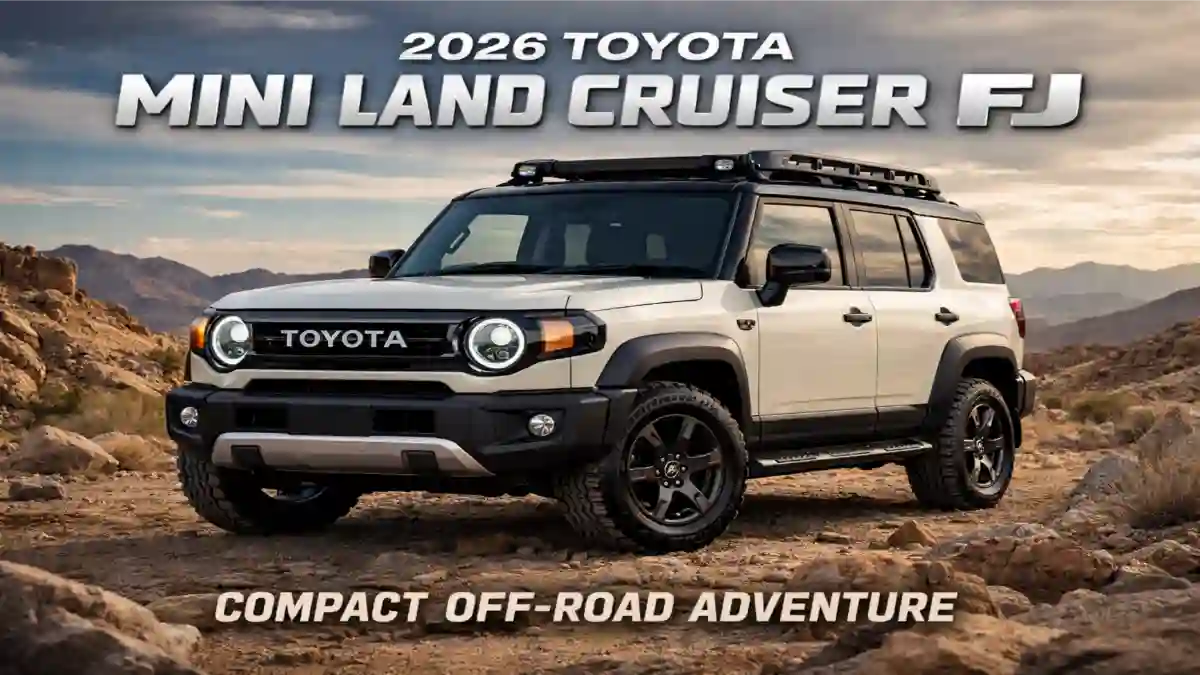
Toyota’s Land Cruiser name has been synonymous with durability and adventure for decades. The new Mini Land Cruiser FJ draws on that legacy with visual cues that will feel familiar to fans of older models. The upright body, squared wheel arches, and robust stance evoke a classic utilitarian ethos, reinterpreted for a contemporary compact SUV. The design includes heritage-inspired elements such as round headlight options and exterior ruggedness that nod to iconic predecessors while remaining distinctly modern.
This exterior is not merely cosmetic. The muscular proportions and high ground clearance signal real capability off the beaten path. Short front and rear overhangs improve approach and departure angles for technical terrain, and protective body cladding reinforces durability for rock, mud, and gravel. These are functional design decisions as much as stylistic ones.
Platform and Engineering Philosophy
Beneath its compact body, the Mini Land Cruiser FJ is built on Toyota’s IMV platform, a ladder-frame architecture shared with Toyota’s Hilux pickup truck family. This choice sets it apart from many unibody crossover SUVs and gives it inherent strength and robustness typically associated with larger off-road vehicles. The platform supports a body-on-frame construction, a layout that enhances structural rigidity and is preferred in serious off-road driving.
Toyota has focused on retaining the Land Cruiser’s core values of reliability and strength. The name “FJ” itself is now officially defined as “Freedom & Joy,” a mantra that reflects the brand’s intent to make adventure more accessible and rewarding for a broader group of drivers.
Compact Size With Practical Proportions
In physical dimensions, the FJ sits comfortably between small city SUVs and larger off-road machines. It measures approximately 4575 millimeters in length, 1855 millimeters in width, and 1960 millimeters in height, with a wheelbase of about 2580 millimeters. These proportions give it manageable road manners and tight turning ability while offering more interior space than many competitor vehicles in the compact segment.
Toyota’s decision to position the FJ below traditional Land Cruiser models reflects an understanding of shifting consumer preferences. Buyers today seek vehicles that are capable but also practical for daily commuting, urban environments, and weekend excursions without the size and cost penalties of a full-size SUV.

Powertrain and Performance Realities
Under the hood, the FJ is expected to be powered by a 2.7-liter naturally aspirated petrol engine. This four-cylinder unit produces in the range of 160 to 163 horsepower and approximately 245 to 246 Newton-meters of torque. This power output is modest compared to large SUVs but calibrated for balance between everyday usability and off-road grunt.
Transmission duties are handled by a 6-speed automatic gearbox, paired with a part-time four-wheel-drive system. Toyota’s proven 4WD technology brings confidence on loose surfaces, steep climbs, and uneven trails. This drivetrain configuration aligns with the brand’s philosophy of dependable mobility in diverse conditions.
The integration of a robust 4×4 system and capable suspension components suggests that the FJ is more than a styled crossover. Toyota has equipped it with hardware designed to face challenging landscapes, from rocky trail stretches to soft sand dunes. These mechanical choices imbue the FJ with traction, balance, and composure in off-road scenarios.
Interior Layout and Daily Usability
Inside, the Mini Land Cruiser FJ’s cabin aims for a blend of function and comfort. Reports indicate a practical dashboard layout with straightforward controls and a touchscreen infotainment system compatible with contemporary connectivity standards, including smartphone integration. The focus here is on durability and intuitive operation rather than luxury.
Seating for five passengers is typical of this class, and foldable rear seats expand cargo capacity for outdoor gear. Dual-zone climate control and a digital instrument cluster are among the features that enhance daily comfort and usability. Toyota seems intent on making the FJ not just a weekend warrior but a competent all-rounder.
Pricing and Market Strategy
Although Toyota has not formally announced exact figures, several sources indicate that in India the FJ could be priced in the ₹20 lakh to ₹25 lakh range for early variants. This would make it one of the most accessible vehicles bearing the Land Cruiser badge in the Indian market.
Launch timelines for India remain tentative, with reports suggesting a potential introduction around 2027 or later, dependent on market demand and local preparation. Toyota’s strategy appears to be cautious yet responsive, tailoring production and distribution plans to regional interests.

The company is launching the FJ first in Japan around mid-2026, with global rollouts following. It does not intend to sell this model in North America or Europe initially, focusing instead on markets in Asia, the Middle East, and Latin America where rugged compact SUVs have strong appeal.
Off-Road Capability and Real-World Potential
Real-world impressions and early walkaround reviews highlight that the Mini Land Cruiser FJ embraces serious off-road capability within its compact footprint. High ground clearance and short overhangs, combined with the traditional ladder frame, give it leverage in uneven terrain. Observers have noted its traction systems and chassis articulation potential as indicators of genuine ability in trail conditions.
While the FJ may not match large off-road trucks in raw power, its balance of agility, torque delivery, and chassis tuning could make it a satisfying vehicle for weekend adventures, national park trails, and remote excursions. The wide rear cargo space and practical interior further enhance its appeal for extended journeys.
Customization Opportunities and Aftermarket Interest
The FJ concept has sparked early interest among customization and off-road aftermarket communities. The simplicity of its design and body panels, combined with Toyota’s modular engineering, suggests that accessories such as winches, roof racks, all-terrain tires, and suspension upgrades will be popular offerings. Collectors and lifestyle owners may personalize their FJ SUVs for expedition use or overland touring.
Long-Term Relevance in Toyota’s SUV Lineup
Toyota’s decision to reintroduce the Land Cruiser FJ nameplate in a compact form signals a broader shift in the SUV market toward vehicles that balance capability with efficiency and everyday usability. The FJ sits alongside larger Land Cruisers and models like the Fortuner, offering a ladder of choices for buyers with varying needs.
For markets like India, where size, price sensitivity, and versatility are key purchase drivers, the FJ could represent a sweet spot. Its combination of off-road readiness, city friendliness, and brand heritage gives it a unique position in a crowded SUV segment where practicality and identity matter equally.
In this respect, the Mini Land Cruiser FJ is not just another compact SUV. It is a purposeful reinterpretation of a beloved nameplate that makes space for new kinds of ownership stories, from weekend treks into wild terrain to daily commutes through urban streets.