
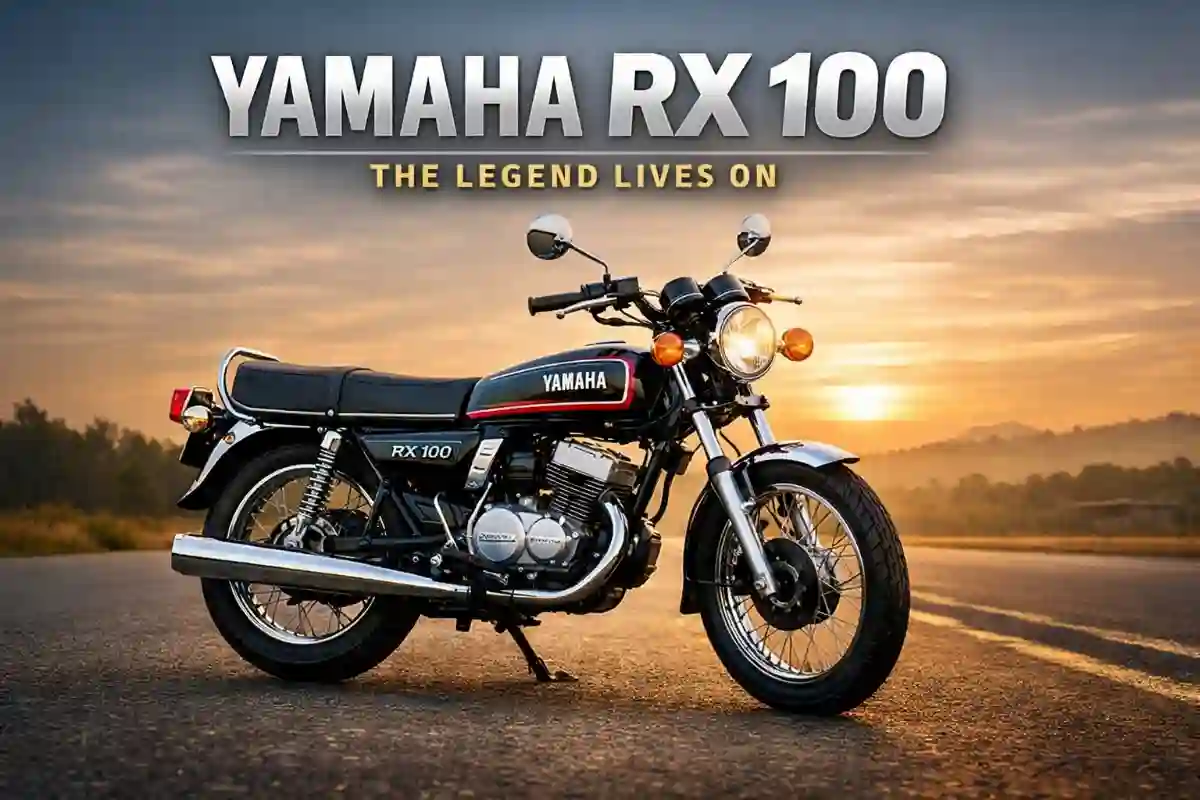
Yamaha RX 100: Few motorcycles hold a place in India’s cultural imagination quite like the Yamaha RX 100. To this day, decades after it stopped rolling off production lines, the RX 100 remains one of the most revered bikes among riders, collectors, and enthusiasts alike. Its legend was forged not just by numbers on a spec sheet but by an emotional bond with a generation that grew up when motorcycles were more about character than technology. In many ways, the RX 100 is not just a motorcycle, it represents an era of performance, freedom, and personal identity on two wheels.
Origins and Early Days
During the mid-1980s, India’s motorcycle market was dominated by utilitarian bikes focused on efficiency and practicality. A machine that could deliver performance and thrill seemed like a distant dream for the average commuter. That changed dramatically in 1985 when Yamaha, through Escorts Limited in India, introduced the RX 100 to a market hungry for excitement.
What made this launch remarkable was not just the arrival of a new model, but its philosophy. Instead of prioritising frills or fuel economy above all else, the RX 100 brought exhilarating performance to the mainstream. With its lightweight chassis and a potent 98cc, air-cooled two-stroke engine, the bike offered a power-to-weight ratio few could match at the time. It wasn’t built for cautious commuting; it was built to stir emotions.
Design Language That Spoke to the Soul
The RX 100 carried a design that was bold in its simplicity. At a time when the Indian two-wheeler market was filled with boxy utilitarian shapes, this bike stood out with its clean lines and purposeful stance. The teardrop fuel tank was compact yet muscular, hinting at the power contained within. Minimal body panels revealed more of the engine and frame, reinforcing a raw mechanical aesthetic that appealed to purists.
The flat, elongated seat wasn’t just about classic styling; it made the bike feel agile and responsive under the rider. The round headlamp and chrome accents added a touch of visual flair without overwhelming the bike’s overall silhouette. Even today, when retro aesthetics are in vogue, the RX 100’s design feels relevant and striking.
Performance That Turned Heads
In the context of 1980s India, the RX 100’s performance was nothing short of revolutionary. Its two-stroke, single-cylinder engine produced around 11 horsepower, a figure that seemed modest on paper but translated into thrilling acceleration thanks to the bike’s featherweight of roughly 103 kilograms. A top speed of around 100 to 110 km/h placed it well ahead of many contemporaries.
That two-stroke engine gave the RX 100 a distinctive character: immediate throttle response, a potent mid-range punch, and a memorable exhaust note that became part of its identity. Riders often recall how opening the throttle felt like unlocking a surge of energy that modern commuter bikes simply could not replicate.

Handling, too, was a strong suit. The bike’s light frame made it exceptionally nimble on congested city streets and surprisingly confident on open stretches. The suspension setup struck a balance between agility and comfort. Braking was handled by drum brakes front and rear, adequate for the era though a little dated by modern standards.
Real-World Riding Impressions
To truly appreciate the RX 100, one must step out from the numerical to the experiential. For many riders in the 80s and 90s, this bike was a rite of passage. College students and young professionals dreamt of the day they could call one their own. Owning an RX 100 was, in many ways, an aspirational statement, proof that you valued performance and character over mere transportation.
On the road, the RX 100 offered a ride that was visceral and engaging. The engine’s responsiveness made it feel alive; every twist of the throttle brought an immediate, exhilarating reaction. Maneuvering through traffic felt effortless, and the bike’s compactness made navigating tight corners second nature. Enthusiasts often recount long rides where the bike’s spirited nature turned even mundane routes into memorable journeys.
Long trips were equally thrilling. While the RX 100 lacked modern comforts like advanced suspension or digital instrumentation, its mechanical simplicity meant fewer things to go wrong during extended rides. Riders embraced the minimalist nature, finding beauty in its straightforward, no-nonsense approach to motorcycling.
Cultural Impact and Legacy
The RX 100’s cultural influence extends far beyond its production years, which ended in 1996 due to increasingly strict emissions regulations that made two-stroke engines less viable. By that time, the bike had already cemented a legacy as one of India’s most iconic motorcycles. Its presence in films, street races, and youth culture stories only amplified its legend.
Even today, more than two decades after production ceased, the RX 100 commands a passionate following. Enthusiasts hunt for well-maintained vintage models, invest in restorations, and preserve them as prized possessions. Some have become collector’s items, fetching high prices in the used market that rival newer motorcycles lacking the same heritage.
There’s a thriving community built around this bike. Mechanics who specialise in restoration, clubs where owners share stories and parts, and an almost ritualistic care given to maintaining these machines. This is evidence not just of nostalgia but of genuine enduring appreciation.

Revival Rumours and Modern Aspirations
In recent years, there have been speculations and early reports about Yamaha potentially reviving the RX 100 in a modern avatar. These discussions often suggest a bike that retains the spirit of the original while incorporating contemporary technology. While official confirmation remains limited, the buzz highlights the enduring demand for a modern take on a classic.
This ongoing interest speaks volumes about the RX 100’s place in Indian motorcycling culture. It is rare for a motorcycle to be celebrated not just for what it was but for what it continues to represent: pure riding pleasure.
Enduring Relevance in Modern Times
What truly sets the RX 100 apart from countless bikes that have come and gone is its emotional resonance. It is not merely a machine; it is a narrative of youth, freedom, and the open road. Whether you grew up waiting to ride one or only recently discovered its legend through enthusiast communities, the RX 100 continues to captivate.
In a world where motorcycles are increasingly defined by technology and electronics, the RX 100’s analogue soul offers a refreshing contrast. Its mechanical simplicity forces riders into a deeper connection with the machine, a relationship that modern bikes, for all their convenience, sometimes struggle to evoke.
Closing Thoughts
The Yamaha RX 100 is more than the sum of its specifications. Its legacy is woven into the cultural fabric of Indian motorcycling, a testament to what happens when engineering passion meets rider enthusiasm. It defined performance for a generation, inspired countless journeys, and continues to be revered long after its official production ended.
Owning or riding an RX 100 is, for many, not just about transportation. It is a way of holding on to memories, celebrating heritage, and experiencing the pure joy of riding unfiltered by modern complexity.
In every twist of the throttle and every rumble of its exhaust, the RX 100 reminds us why motorcycles are more than machines, they are companions on the road of life.