- 1. Striking Exterior Modifications Express Subtle Evolution with Practical Purpose
- 2. Interior Refinement Sets a Higher Standard for Comfort and Connectivity
- 3. Performance and Driving Dynamics Reflect Practical Balance, Not Performance Excess
- 4. Technology Integration Signals a Shift Toward a More Connected, Safety-Focused Experience
- 5. Segment Positioning and Market Considerations Highlight Honda’s Strategic Choices
- 6. Challenges and Competitive Pressures Illuminate the Road Ahead
- 7. Future Focus on Connectivity, Safety, and Sustainable Mobility
Honda HR-V: Honda’s 2026 iteration of its compact crossover SUV, the HR-V, is shaping up to be one of the more consequential updates in the brand’s recent lineup, especially as competition intensifies in the subcompact SUV segment. With fresh styling cues, upgraded cabin technology, and expanded driver assist systems, Honda is positioning the 2026 HR-V to appeal to a broad spectrum of buyers, including tech-savvy younger consumers and families seeking a versatile, well equipped SUV experience. Early reports and official releases indicate this model is not a complete redesign but a meaningful refresh that balances evolutionary refinement with timely feature additions.
Striking Exterior Modifications Express Subtle Evolution with Practical Purpose
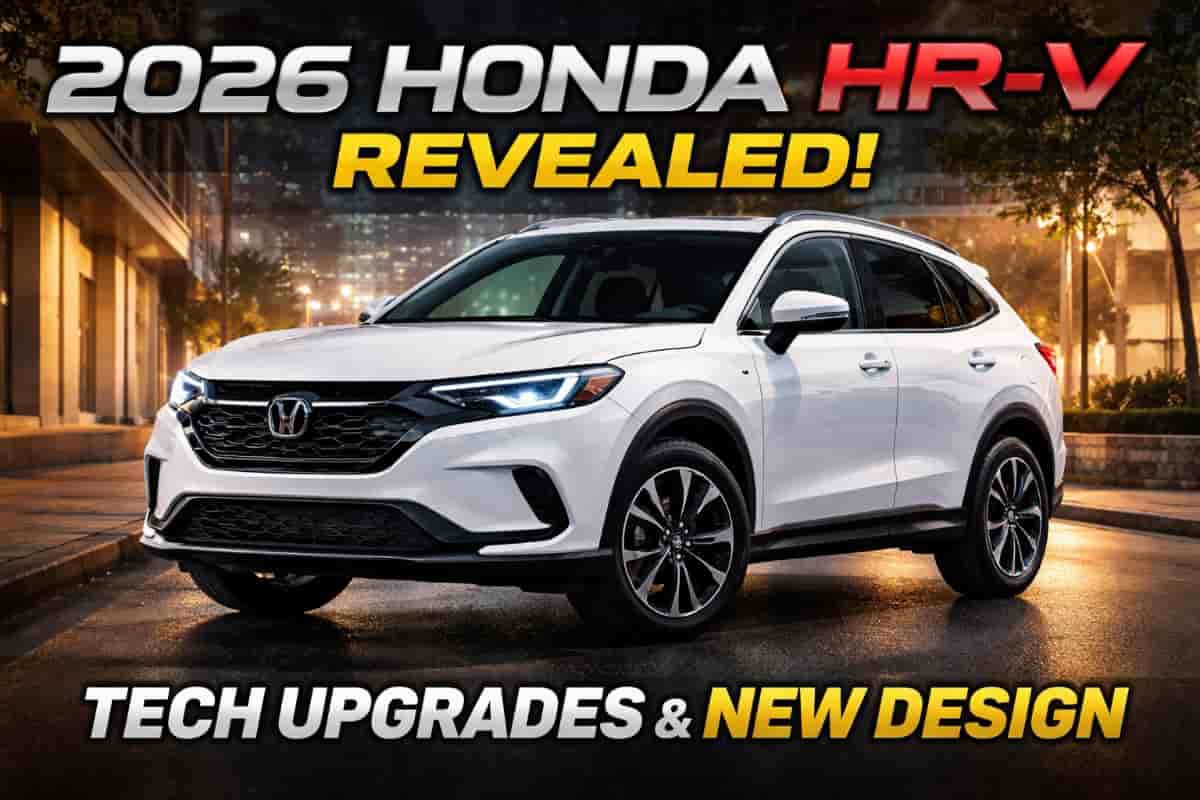
The most noticeable changes on the exterior of the 2026 Honda HR-V are measured rather than radical. Honda has applied updated styling details that align the model more closely with its larger CR-V sibling, incorporating sharper lines and a bolder front fascia that give the SUV a more assertive road presence. Subtle shifts in lighting graphics, sleeker headlamp assemblies, and refined wheel designs help distinguish this model year from its predecessor while preserving the original proportions and overall silhouette that buyers have come to expect.
Honda offers the 2026 HR-V in multiple trims globally, including a base LX, a sportier Sport variant with gloss black accents and distinctive 18-inch wheels, and a more premium EX-L grade that emphasizes comfort and elevated interior appointments.
The exterior updates may be most appreciated by buyers who prefer a vehicle that feels contemporary without the shock of a full redesign. This approach reflects Honda’s strategy of incremental refinement rather than wholesale reinvention at this stage of the HR-V’s lifecycle.
Interior Refinement Sets a Higher Standard for Comfort and Connectivity
Inside, the 2026 Honda HR-V has undergone one of its most significant upgrades in recent memory. The centerpiece of the cabin is a larger 9-inch touchscreen infotainment display that supports wireless Apple CarPlay and wireless Android Auto connectivity. This enhancement delivers a user experience more in line with current consumer expectations and is a response to feedback that earlier models lagged behind in screen size and intuitive connectivity.
The dashboard design integrates the new screen with cleaner lines and an ergonomic layout that places key controls within easy reach of the driver. Premium touches such as available leather trim, ambient footwell lighting, and a one-touch power moonroof in higher trims emphasize comfort at both daily commute and long-distance levels. Heated front seats and dual-zone climate control are also offered on selected trims, reinforcing a sense of refinement not always found in this segment.

Seating for five remains standard, and the 60/40 split second-row seats promote practical versatility. Cargo capacity is competitive for the class, providing adequate space for weekend gear without compromising passenger comfort.
Performance and Driving Dynamics Reflect Practical Balance, Not Performance Excess
Under the hood, the 2026 HR-V continues with a 2.0-liter four-cylinder petrol engine that produces 158 horsepower, paired with a continuously variable automatic transmission. Although this powertrain does not deliver athletic performance compared to some rivals, Honda emphasizes balance between real-world responsiveness and fuel efficiency.
The chassis system, including MacPherson strut front suspension and a multi-link rear configuration, enhances ride quality and contributes to confident handling in diverse conditions. Optional Real Time All-Wheel Drive with Intelligent Control System is available, broadening the HR-V’s appeal in markets where road conditions vary widely.
Driving modes such as ECON, Normal, and Snow support adaptability across environments, from urban roads to light off-road scenarios. Hill descent control and hill start assist expand the SUV’s practical capabilities beyond what is typical for some competitors.
Technology Integration Signals a Shift Toward a More Connected, Safety-Focused Experience
Technological enhancements in the 2026 HR-V extend beyond infotainment. Honda’s Sensing suite of driver assistive technologies comes standard, offering features such as adaptive cruise control with low-speed follow, forward collision warning, lane keeping assist, traffic sign recognition, and collision mitigation braking. These systems work together to elevate everyday safety and ease the burden of stop-and-go traffic or long highway stretches.
In addition to driver aids, the SUV includes practical connectivity features such as a wireless phone charger and an available eight-speaker audio system that improves in-cabin entertainment quality. Blind spot information and cross traffic monitoring are available on selected trims, enhancing situational awareness in crowded urban settings or tight parking environments.

Segment Positioning and Market Considerations Highlight Honda’s Strategic Choices
Globally, the HR-V has been a key piece of Honda’s SUV portfolio, bridging a gap between smaller crossovers and larger compact SUVs. In markets such as the United States, it is one of Honda’s top-selling models among younger buyers. For 2026, Honda appears to be doubling down on that audience by infusing the model with contemporary tech and design elements that resonate with digital-native drivers.
In India, where the subcompact SUV segment is intensely competitive, the HR-V’s arrival is anticipated though pricing and specifications may differ from global markets. Industry expectations place the HR-V’s Indian launch in mid-2026 with a projected price reflective of local tax structures and import duties. Domestic rivals such as the Hyundai Creta, Kia Seltos, and Tata Harrier have set high benchmarks, and Honda’s challenge will be to match aspirational features with value-oriented pricing.
Challenges and Competitive Pressures Illuminate the Road Ahead
Despite the 2026 HR-V’s strengths, there are areas where the SUV may face criticism. The decision to retain a single 2.0-liter engine for many markets could be seen as a limitation compared to rivals that offer turbocharged or hybrid powertrains with stronger performance and improved efficiency. Early impressions from automotive reviewers point out that the HR-V’s engine and transmission combination can feel less responsive under spirited driving conditions.
There is also the broader question of electrification. Honda, like many manufacturers, is progressively expanding its electric and hybrid offerings. For markets such as Australia, reports indicate Honda plans to introduce its first fully electric SUV in 2026, possibly using the HR-V as a platform base. Such developments suggest that the current 2026 HR-V may be positioned as a transitional model while Honda accelerates its electrification roadmap.
Future Focus on Connectivity, Safety, and Sustainable Mobility
As buyers weigh the merits of the 2026 Honda HR-V against a crowded field, the SUV’s strengths in interior comfort, tech integration, and safety features are likely to resonate broadly. Honda’s judicious refresh reflects a company balancing tradition with the need to evolve. Future iterations of the HR-V could accelerate electrification and expand performance choices, yet for the 2026 model year, this SUV represents a pragmatic and compelling option for those seeking modern connectivity, capable driving dynamics, and a well-rounded suite of driver aids.
The 2026 Honda HR-V’s blend of incremental innovation, thoughtful design updates, and strategic positioning underscores its potential to remain a significant player in the subcompact SUV segment worldwide. As it enters various markets with localized specifications and features, the industry will be watching closely how consumers respond to this intersection of contemporary tech and practical automobile engineering.